Plum in Prison

Plum in Prison. Radio 4, 23 December 2025, 2.15pm
Reeves If I may say so, sir, your disposition inclines you to think the best of people.
Plum I like to give a fellow a good shake.
Reeves An admirable policy, sir, but one which may founder on the worst of people.
In May 1940, the British novelist P.G. Wodehouse was in a villa in Le Touquet on the Northern French coast when German army swarmed across the Belgian border and began to occupy France. Wodehouse (‘Plum’ to his friends) was arrested and interned. Plum was popular among his fellow inmates and used his connections to help some of them, helping to get word out and supporting their families. After a year Wodehouse was released from internment and he made a series of broadcasts from Berlin about conditions in his prison camp.
That Wodehouse chose to broadcast on German radio was greeted with deep anger back in Britain. In a country that had been suffering consistent bombing raids and other military reversals for the past year, Wodehouse was denounced as a traitor in the press, on the BBC, and in parliament. His conduct was subject to an official investigation. He never returned to the UK. Despite being one of the most popular and beloved British novelists of the twentieth century, a shadow hung over his reputation and he remained conspicuously un-honoured until a hastily-arranged knighthood in 1975 on the eve of his death.
In this new play, I re-examine the affair. It seems to me that Wodehouse’s actions are complicated in their intention and effect. It is very clear that Wodehouse was a naïf. Robert McCrum’s superb biography suggests that he was a kind of arrested adolescent who created innocent worlds into which the twentieth century barely impinged. It is quite clear that Wodehouse had no sympathy for the Nazis and did not broadcast with any deliberate intent to offer support for the German cause. It is also the case that he was interned for the year before the broadcasts and may have been unaware, even if were constitutionally suited to this kind of awareness, of the progress and conduct of the war and therefore not cognisant of the sufferings of the British. It is also clear that he did not buy his freedom (such as it was) by agreeing to do the broadcasts, which he had agreed to do before the offer of release from internment was made. And yet he was not a stupid man and might have been expected to think how it might look. Although the broadcasts did not help the Germans or deliver them any real propaganda coup, it is clear they wanted to use Wodehouse’s broadcasts to persuade America that the Nazis were humane and therefore to stay out of the war, just as they were beginning their attack on the Soviet Union. Another man might have figured some of this out but not Plum. In some ways, it is the unworldliness of Wodehouse that is so exasperating here — just as it is so endlessly delightful in his books.
I’ve written a play trying to place us in Wodehouse’s position, trying to understand how it might have seemed a reasonable thing to do. But I have also tried to create a structure for the play that evolves gently into a kind of Wodehousian farce. I have a suspicion that if Orwell or Auden had been interned and made such broadcasts, they would have been censured less severely, because Wodehouse was funny and these men were serious. I think Britain is both a country that prides itself on a sense of humour but also fundamentally mistrusts laughter. My play tries both to understand Wodehouse’s actions and to be funny about them.
I appreciate that there is some risk in that. Some will wonder if I it is ever quite right to be funny about the Nazis? But I don’t think laughter is trivialising; it seems to me, and always has seemed to me, that laughter can be clarifying and enlightening. And so, in a small way, I hope that the play’s laughter will enhance and enrich the play’s understanding — as well as making you laugh.
We had a terrific cast: Stephen Mangan is Wodehouse, a great bit of casting that moves Plum away from seeing him as a kind of Bertie Woosterish ‘silly ass’ and someone a little more gentle, thoughtful, grounded; Clare Lawrence Moody and Harley Viveash (who were wonderful in Our Mutual Friend) play Bunny and Meadowes/McKenzie; Max Runham (who was in 7 Ghosts) plays various Germans; Graeme Hawley (Dead Souls & Cavalry) plays Reeves and Webb, and Silas Carson plays Buchelt. The sound designer is Steve Brooke (who has done numerous of my plays) and the producer as ever is the wonderful Polly Thomas.
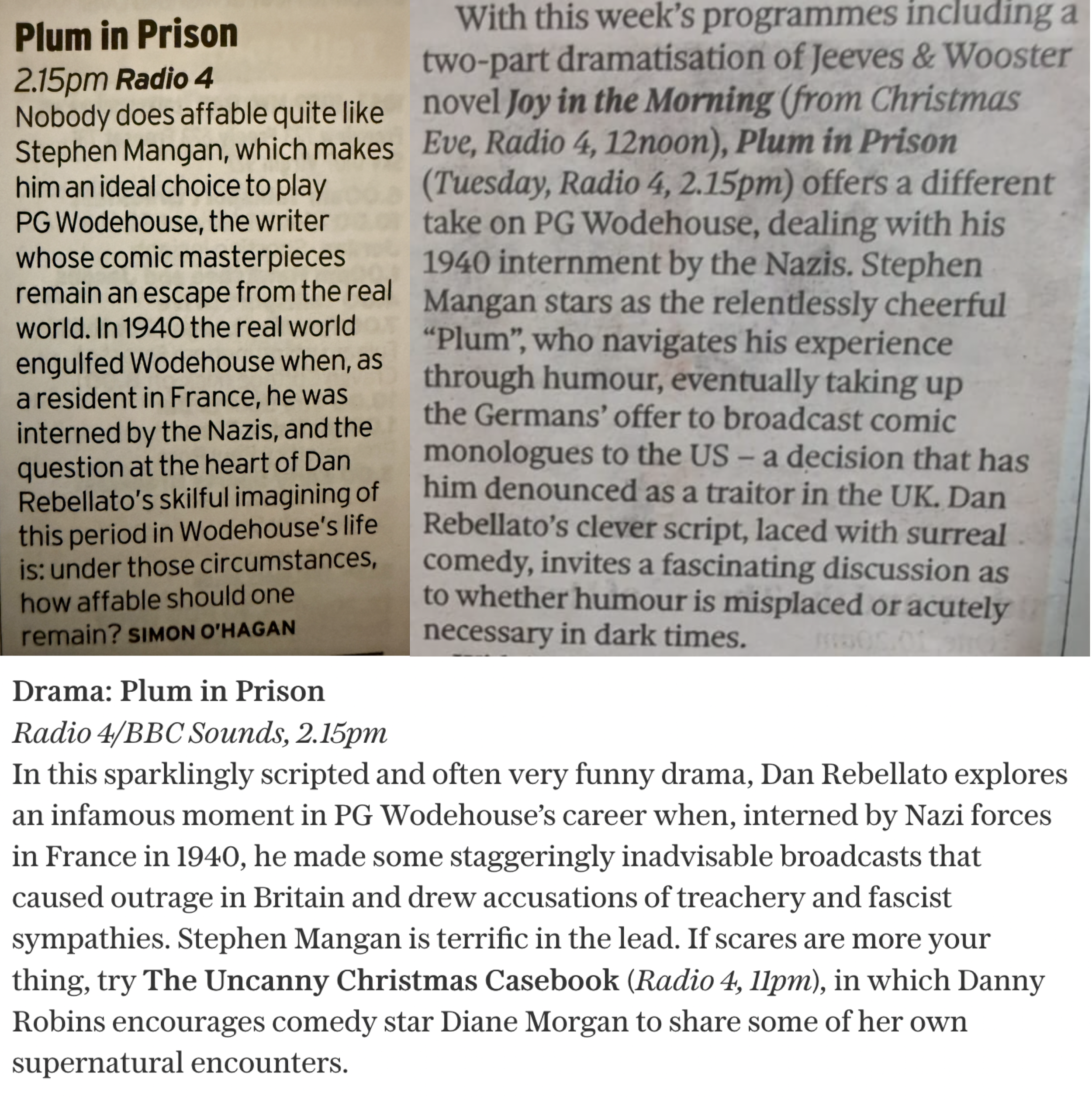
We’ve had some nice previews. Here are some of them (top left: Radio Times; top right Observer; bottom: Telegraph)

![photo[1].jpg](https://images.squarespace-cdn.com/content/v1/513c543ce4b0abff73bc0a82/1362919072201-PZO854G4SEB794DVOEI8/photo%5B1%5D.jpg)